
Search for a waterfall restaurant in Bali and the same stretch of river keeps coming back. Most of what the island offers under that name sits within a few hundred metres of one waterfall, in one regency, and almost all of it is built for the middle of the day.
That is worth knowing before you book, because "waterfall dining" covers two completely different experiences. One is a destination you drive to, photograph and leave. The other is a place where the water was there before the kitchen was, and still runs when the last table has gone. Both are worth doing. They are not interchangeable, and the difference decides whether you should plan an afternoon or a stay.
Where Bali's waterfall dining actually is
The cluster is Tegenungan, in Gianyar, about twenty minutes south-east of Ubud. It is the island's most accessible waterfall — no long descent, parking close to the viewing platforms — and that accessibility is exactly why the dining grew around it rather than around the harder, more dramatic falls in the north.
What that means in practice: the venues share a waterfall, a road and a timetable. They fill between late morning and sunset, they are busiest at weekends, and the view you are paying for is one you share.
| Venue | Where | What it is | The waterfall |
|---|---|---|---|
| OMMA Bali | Tegenungan, Gianyar | Day club with restaurant, pool and swing | Tegenungan, in view from the terraces |
| D’Tukad River Club | Tegenungan, Gianyar | River club and coffee club, treehouse-style seating | Tegenungan, with Tegalalang rice terraces as the alternative view |
| The Kayon Jungle Resort | Ubud, Gianyar | Resort dining — Kepitu Restaurant and The Canyon Jetty Restaurant | River below and cascades audible from the dining areas |
| Ambu at Nirjhara | Kedungu, Tabanan | Farm-to-table restaurant inside a 25-villa property | The property’s own cascade, with the infinity pool above it |
Three of those four are in Gianyar. The fourth is in Tabanan, which is a different proposition entirely, and we will come back to why.
Day club or dining room
The honest division is not between good and bad. It is between a day out and a meal.
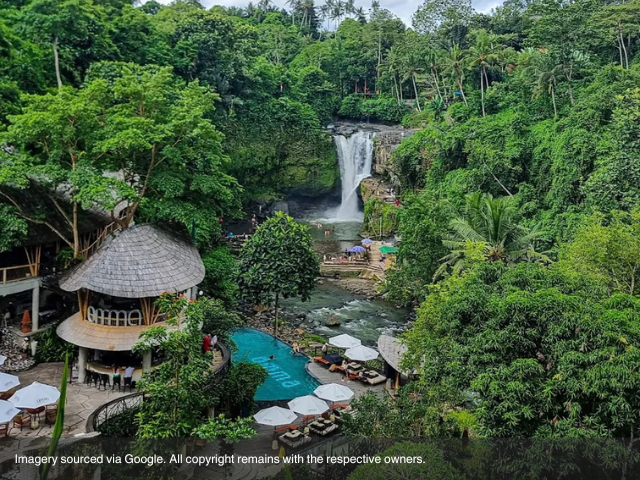
OMMA Bali describes itself as a waterfall day club, and that is accurate: pool, swing, tables, a view of Tegenungan, and a crowd that arrives for the setting. It is a well-run version of a specific thing. You go for the middle of the day, not for dinner.
D'Tukad River Club sits on the same river with a coffee club and raised seating. Its own description offers Tegenungan or the Tegalalang rice terraces as the view, which tells you something useful — it is positioned as a viewing platform with a kitchen attached, and it leans on the adventure side as much as the dining side.
The Kayon Jungle Resort is the first on the list where food leads. Kepitu Restaurant and The Canyon Jetty Restaurant are resort dining rooms, and the resort's own account of them describes the river running beneath and cascades you hear rather than photograph. That is a different register: the water is the room's atmosphere, not its attraction.
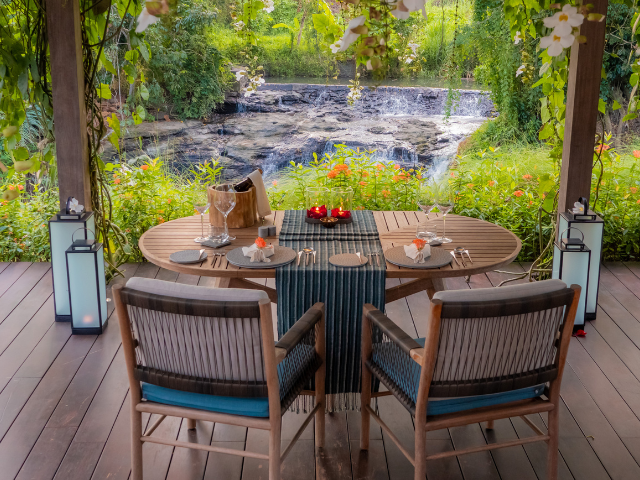
Ambu at Nirjhara is the only one of the four where the waterfall is not shared with anyone who has not come to stay or to eat. The property is built along its own cascade in Kedungu, Tabanan, and the restaurant works farm-to-table from a 700m² organic garden on site. The MICHELIN Guide, which lists the property with One Key, describes the infinity pool overlooking that waterfall.
Why Tabanan changes the answer
Gianyar has the famous waterfalls and the traffic that follows them. Tabanan — Bali's green agricultural province — has the subak irrigation system, the rice terraces at Jatiluwih about forty-five minutes inland, and a coast that most visitors drive past.
That matters for a meal because of one practical thing: at Tegenungan you are eating at a public attraction, and the waterfall closes when the attraction does. At a property built on its own water, dinner is the quiet part of the day rather than the end of a queue. Kedungu Beach is two minutes away with three surf breaks, Tanah Lot is seven minutes up the coast, and Ubud is about an hour inland — so the famous waterfalls remain a day trip rather than the reason you are there.
Why the other waterfalls have no restaurants
Bali's most dramatic waterfalls are in the north and the centre, and almost none of them has dining of any consequence. That is not an oversight in the market. It is topography.
Sekumpul, Nungnung and the northern falls sit at the bottom of steep ravines reached by long flights of steps. A restaurant needs deliveries, refrigeration, staff arriving twice a day, waste leaving, and a kitchen that can be inspected. None of that travels well down four hundred steps. What those waterfalls support is a warung at the top of the descent and a ticket booth, which is a different business from a restaurant.
Tegenungan is the exception because it is the one major waterfall you can effectively park beside. The viewing platforms are close to the road, the gradient is manageable, and the land above the falls is buildable. Every commercial consequence of that — the day clubs, the swings, the coffee clubs, the queues — follows from a single geographic fact.
So the honest shape of the market is this: one accessible waterfall with a cluster of venues around it, a handful of resorts with water on their own land, and a long list of spectacular falls where the only food is at the car park.
What changes when the kitchen is on the water
Dining beside moving water is not only a view. It changes three things that matter during a meal, and none of them photographs.
Sound. A waterfall is loud, and the volume is not constant — it rises after rain and drops in the dry months. Close to a fall, conversation across a table of six is work. A little further back, the same water becomes the thing that removes traffic, music and the next table from your evening. The best waterfall dining rooms are deliberately set at the second distance, not the first.
Temperature. Moving water and jungle shade drop the air temperature noticeably against open ground in the same regency. In Bali that is the difference between an outdoor table at seven in the evening being pleasant or being endured.
Light. This is the one that catches people out. A waterfall in a ravine loses its light before the sky does, often by a good half hour. A venue that markets a waterfall view and serves dinner at eight is selling you the sound, not the view — which is fine, but worth knowing before you book the late sitting for the photograph.
Farm-to-table, next to the water
The phrase has been used loosely enough in Bali to mean almost nothing, so it is worth being specific about what it means when the garden and the restaurant are on the same site.
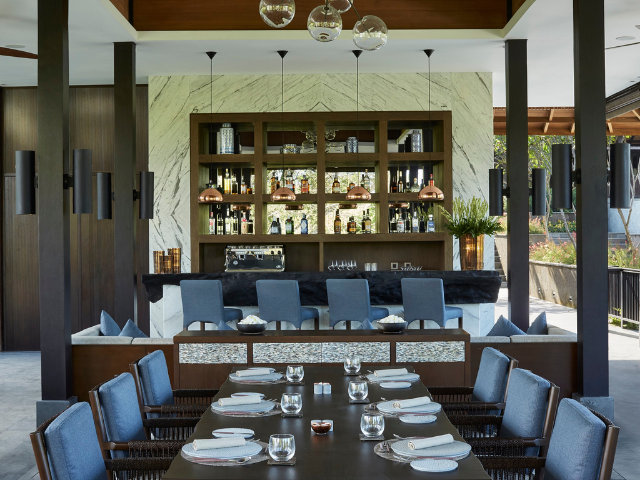
At Nirjhara, Ambu is the property's farm-to-table restaurant, and the garden supplying it runs to 700m² and is organic. Tabanan is Bali's green agricultural province — the regency that feeds a good part of the island, worked through the subak irrigation system — so "local produce" here means produce from the valley the restaurant sits in rather than produce trucked across the island.
The MICHELIN Guide's inspectors describe Ambu as serving refined Balinese cooking in an open-air setting, and list the property with One Key. That matters less as a credential than as a description: the food is the point, and the waterfall is the room.
The practical difference against a day club is simple. At a venue built around a public waterfall, the kitchen serves a view. At a property built along its own water, the kitchen serves a garden, and the water is why the building is where it is.
What to check before you book
Waterfall venues have a specific set of failure modes, and none of them appear in photographs.
| Check | Why it matters |
|---|---|
| Season | Wet season means more water and more mud. Dry season means a thinner fall and firmer ground. The photograph you saw was taken in one of them |
| Time of day | Most Tegenungan venues are built for daylight. Ask whether the waterfall is lit, or visible at all, after sunset |
| Entrance versus minimum spend | Some venues charge entry, some require a minimum spend, some fold a sun-lounger into the bill. Establish which before you arrive |
| Access to the water | “Waterfall view” and “waterfall access” are different products. Steps down to a river are not always open, and not always short |
| Swimwear and dress | Day clubs expect swimwear. Resort dining rooms generally do not |
| Who else is there | A public waterfall at midday on a Saturday is a different place from the same waterfall at nine on a Tuesday |
Eating where the water lives
There is a reason the island's waterfall dining is concentrated rather than spread. Bali's spectacular falls — the ones in the north, the ones that need a proper descent — are hard to build beside and harder to serve food at. So the dining gathers at the one waterfall you can park next to.
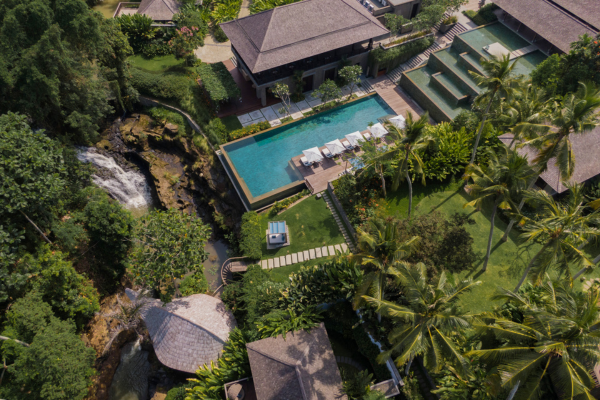
The alternative is not another waterfall with another car park. It is a property where the water was the reason for the architecture. At Nirjhara the cascade runs through the site, the suites are set along it, and 85% of them look at something — river, jungle or rice field — rather than at the next building. Ambu cooks from the garden beside it. The yoga shala, built by IBUKU in bamboo, sits in the same sound.
You can do both in one trip, and most people should: an afternoon at Tegenungan, and dinner somewhere the waterfall is not an attraction with opening hours.
Frequently asked questions
Which waterfall in Bali has restaurants beside it?
Tegenungan, in Gianyar, about twenty minutes from Ubud. It is the island's most accessible waterfall and almost all of Bali's waterfall dining has grown around it, including OMMA Bali and D'Tukad River Club.
Can you eat dinner at a waterfall in Bali?
At the public waterfalls, rarely — most venues around Tegenungan are built for daylight hours. Dinner beside moving water generally means a property with its own cascade, such as Ambu at Nirjhara in Kedungu, Tabanan.
Is waterfall dining in Bali expensive?
It varies more by format than by food. Day clubs commonly charge entry or set a minimum spend on top of the bill, while resort restaurants price the meal alone. Ask which applies before you arrive.
What should I wear to a waterfall restaurant in Bali?
Day clubs expect swimwear and a change of clothes. Resort dining rooms expect ordinary resort dress. If there is any walking down to the river, closed shoes with grip are worth more than they look.
Is the wet season a bad time for waterfall restaurants in Bali?
No, but it is a different experience. There is more water and more noise, which many people prefer, along with mud underfoot and heavier afternoon rain. The dry season gives firmer ground and a thinner fall.
Are Bali's waterfall restaurants suitable for children?
The day clubs generally are, with pools and open space. Anywhere involving steps down to a river deserves a question about the descent before you commit, particularly after rain.
How far is Tegenungan from Tabanan?
Roughly an hour and a half by road, depending on traffic through the south. From Kedungu it is a day trip rather than an evening out, which is the main argument for eating closer to where you are staying.
Does Nirjhara have a waterfall restaurant?
Ambu, the property's farm-to-table restaurant, sits within a site built along its own cascade in Kedungu, Tabanan, with an infinity pool above the waterfall. It is not a public waterfall venue.
Sources consulted
- OMMA Bali — https://www.ommabali.com/
- D'Tukad River Club — https://dtukad.com/
- The Kayon Jungle Resort, dining — https://thekayonjungleresort.com/dining/
- MICHELIN Guide, Nirjhara — https://guide.michelin.com/en/hotels-stays/tabanan/nirjhara-10728


