
Most people see Tanah Lot once, at five in the afternoon, from behind four rows of other people.
It is worth understanding why that happens, because the temple rewards a different kind of visit entirely — and the difference is not effort or money. It is the hour you arrive and the state of the tide when you do.
The temple you photograph and the temple you walk to are two different visits
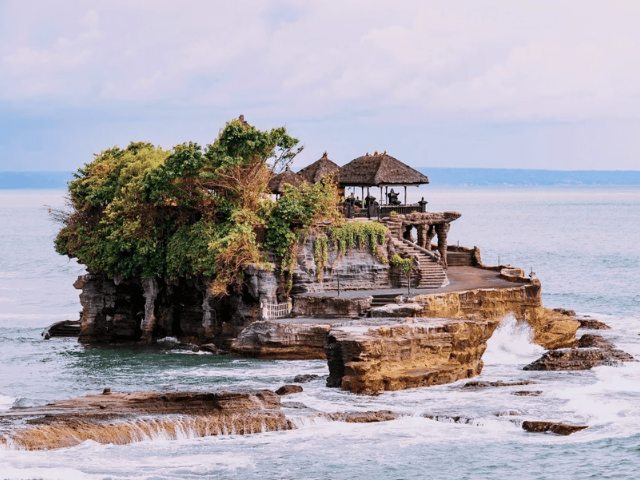
Tanah Lot sits on a rock formation offshore, separated from the mainland by a stretch of sea that appears and disappears twice a day.
At high tide, the rock is an island. The temple stands above the water, unreachable, and the sea breaks white around its base. This is the silhouette on every postcard of Bali ever printed.
At low tide, the sea withdraws and a causeway of black volcanic rock emerges. You can walk across it to the foot of the temple, stand beneath the cliff, and feel the scale of the thing — which no photograph conveys.
Neither state is better. They are different visits, and knowing which one you are getting before you set out is the single most useful piece of planning for this site.
What Tanah Lot actually is
Tanah Lot — tanah meaning land, lot an old Balinese word for sea — is a Balinese Hindu sea temple, and one of the most significant in Bali.
Its founding is attributed to Dang Hyang Nirartha, the Javanese priest who travelled through Bali in the sixteenth century and is credited with establishing a chain of temples along the island's southern and western coasts. Each was sited where the land meets the sea, and each was intended to be visible from the next. Tanah Lot, Uluwatu, Rambut Siwi and Petitenget are links in the same devotional geography.
That chain matters to how you should read the place. Tanah Lot is not a monument built to be looked at. It is a working temple in an active religious landscape, positioned to guard the coast against the spirits the sea was believed to carry. Ceremonies continue on the Balinese 210-day calendar, and on those days access changes without notice.
The temple itself may be entered only by Balinese Hindus at prayer. Visitors reach the base of the rock and no further. This is not a restriction to be negotiated — it is the condition of the place remaining what it is.
At the foot of the cliff is a spring of fresh water rising within reach of the sea, and a cave where sea snakes are held to guard the temple. Both feature in the temple's oral history and both are pointed out by guides. Whether you find that folkloric or genuine depends on how you travel; the Balinese who bring offerings there daily are not in doubt.
How the tides govern your visit
This is the part almost every guide mentions and almost none explains.
Check the tide before you leave. Any tide table for Tabanan or Canggu will do, and most weather applications carry one. You are looking for the state of the tide at the hour you intend to arrive, not the day's high and low.
Low tide opens the causeway. You can cross to the base of the rock, look up at the temple from directly beneath, and photograph the structure with the cliff face behind it. The rock is wet, uneven and slick with algae in places — proper shoes, not sandals.
High tide closes the causeway and gives you the classic composition: the temple apparently floating, the sea running white beneath it. You photograph it from the cliff paths on the mainland, which is where every famous image of Tanah Lot has been taken.
Mid-tide, which is most of the day, gives you a version of both and the full experience of neither.
The practical consequence: if you want to walk across, you need a morning or an afternoon when low tide falls in daylight, and that will not be every day of your stay. If you only want the silhouette, tide state barely matters and you are optimising for light and crowds instead.
When to go, hour by hour
| Time of day | Tide state | What you see | Crowd level |
|---|---|---|---|
| 07:00–09:00 | Usually low | Causeway open, temple base reachable, soft light | Very light |
| 09:00–11:00 | Variable | Good photography, warming light | Light |
| 11:00–15:00 | Variable | Harsh overhead light, least rewarding | Moderate |
| 15:00–16:30 | Variable | Coach arrivals begin | Heavy |
| 16:30–18:30 | Often high | The classic silhouette, full sea surround | Very heavy |
| After sunset | High | Complex empties within 20 minutes, temple lit | Light |
Two windows are worth your attention.
Soon after opening. The complex is close to empty, the light is low and warm, and if the tide cooperates you have the causeway more or less to yourself. Guides are unhurried. The market stalls on the approach have not opened. This is the visit people describe when they say Tanah Lot moved them.
The twenty minutes after sunset. Almost everyone leaves the instant the sun is down. The temple is lit, the crowd evaporates, and the site becomes quiet again while the sky is still colouring. Very few visitors stay for it, largely because they have a long drive ahead of them.
Tanah Lot at sunset, and what most visitors get wrong
Sunset at Tanah Lot is genuinely spectacular. It is also, in high season, extremely crowded, and any guide that tells you otherwise has not been recently.
If you are going for sunset, three things will improve it.
Arrive earlier than you think. Not thirty minutes before — ninety. The main viewing platform fills from about 16:30, and by 17:15 the good positions are gone.
Do not stand on the main platform. The cliff paths running north and south of the central viewing area give you the same alignment with more room, and the southern path puts the Batu Bolong rock arch in the frame. Most of the crowd never walks more than a hundred metres from the entrance.
Stay after. The exodus begins the moment the sun touches the horizon, and the fifteen minutes that follow are the best of the day for photography and the quietest of the evening.
What most visitors get wrong is treating sunset as the visit rather than as one hour of it. They arrive at 16:45 into the heaviest traffic of the day, see the temple from a distance in a crowd, and leave having never crossed to the base or walked the cliff path.
The rest of the complex, which most people miss
Tanah Lot is not one temple. The site includes several shrines along the coastline, and two are worth the walk.
Batu Bolong sits a few hundred metres south, on a natural rock arch running out into the sea, with the waves passing underneath. It is smaller, less photographed, and for many visitors more atmospheric than the main temple.
Pura Enjung Galuh and the smaller cliff shrines sit between the two, along a paved path with the sea on one side.
The full walk takes perhaps forty minutes at an unhurried pace. It is the difference between having seen Tanah Lot and having been there.
Practical planning
Entrance. A fee applies per person, collected at the gate. Rates are adjusted periodically — confirm the current figure on arrival rather than relying on any published number.
Dress. Shoulders and knees covered. A sarong is required to approach the temple base and is available at the entrance. This is an active place of worship.
Footwear. The causeway is wet volcanic rock, uneven and slippery. Sandals are a poor choice.
Ceremonies. Odalan and other observances follow the Balinese 210-day calendar and can restrict access at short notice. If your dates are fixed, ask your hotel to check in the week of your arrival — this is easy for anyone with local relationships and difficult to find online.
Photography. Morning gives you the cliff face and the causeway; late afternoon gives you the silhouette. A neutral density filter is useful for the long exposures of water that the location invites.
The approach. The walk from the car park passes through a long market arcade. It is unavoidable and best treated as part of the visit rather than an obstacle.
Tanah Lot, Uluwatu or Ulun Danu Beratan
Most travellers have time for two of Bali's three signature temples. They are genuinely different experiences.
| Temple | Setting | Best for | Consider that |
|---|---|---|---|
| Tanah Lot | Offshore rock, southwest coast, Tabanan | Sunset, tidal drama, coastal atmosphere | Very crowded at sunset; tide state changes the visit entirely |
| Uluwatu | Clifftop, 70m above the sea, Bukit Peninsula | Cliff views, kecak performance at dusk | Resident macaques take sunglasses and phones; further from Tabanan |
| Pura Ulun Danu Beratan | Lakeside, Bedugul highlands | Reflections, cool mountain air, calm | Frequently misty; the water level changes the composition |
Tanah Lot and Ulun Danu Beratan pair naturally for anyone based in Tabanan — one on the coast, one in the highlands, both within reach without crossing the island.
Getting there, and why where you stay decides your visit
Here is the practical problem with Tanah Lot.
From Seminyak the drive is around an hour in ordinary traffic and considerably longer in the late afternoon, when everyone else is making the same journey. From Ubud it is longer still. That is why the site fills at 16:30 and empties at 18:30: the crowd is on a schedule dictated by the drive.
Which means the two best windows — early morning and after sunset — are effectively closed to most visitors. Not because they are difficult, but because nobody wants a 05:30 departure or a night drive back across the island.
Staying in Tabanan removes the constraint entirely.

Nirjhara sits in Kedungu, a fishing village on the southwest coast in Tabanan — Bali's green agricultural province — seven minutes from Tanah Lot. Morning visits become ordinary. Staying after sunset costs you nothing. The temple stops being a day trip and becomes something you can do twice, differently, on two tides.

The property also runs complimentary daily guided cycling tours to Tanah Lot, through the villages and rice fields between Kedungu and the coast. Arriving at a sixteenth-century sea temple by bicycle, through working farmland, is a materially different experience from arriving by coach.
Nirjhara itself is a 25-villa property built along a river that forms part of the subak irrigation system — the thousand-year-old Balinese water-management network recognised by UNESCO in 2012. A waterfall runs beneath the pool deck. Eighty-five per cent of the suites face the valley. The Jungle Pool Villa and The Residence open directly onto the jungle, and Ambu serves from a 700m² organic garden on the property. The airport transfer is approximately ninety minutes.
For a traveller building a Bali itinerary around culture rather than beach clubs, the location does the work: Tanah Lot at seven minutes, the rice terraces of Jatiluwih at forty-five.
Tanah Lot Temple FAQs
What is the best time of day to visit Tanah Lot Temple?
Early morning, between 07:00 and 09:00, when the tide is usually low, the causeway to the temple base is open and the site is close to empty. Sunset is the most photographed hour and by far the most crowded.
Can you walk to Tanah Lot Temple?
You can walk across the rock causeway to the base of the temple at low tide. At high tide the rock is surrounded by sea and the causeway is closed. Only Balinese Hindus may enter the temple itself.
How long do you need at Tanah Lot?
Ninety minutes covers the main temple, the cliff walk and Batu Bolong. Allow two to three hours if you are staying for sunset, most of which is spent waiting for the light.
Is there a dress code at Tanah Lot?
Shoulders and knees should be covered. A sarong is required to approach the temple base and is available at the entrance. Dress respectfully: this is an active place of worship, not a viewpoint.
Is Tanah Lot worth visiting?
Yes, if you arrive at the right hour. Visited at 17:00 in high season it is a crowded photo stop. Visited soon after opening, with the causeway walkable, it is one of the most atmospheric places in Bali.
How far is Tanah Lot from Nirjhara?
A seven-minute drive. Nirjhara also runs complimentary daily guided cycling tours to Tanah Lot through the surrounding villages and rice fields.


