
For most northern-hemisphere readers, "rainy season" means a fortnight of grey skies and days lost indoors.
That is not what happens in Bali. The usual pattern is a bright, clear morning, cloud building through the middle of the day, and a heavy storm in the late afternoon or overnight that passes within a few hours. You lose an afternoon. You do not lose a day.
That does not make the wet season better than the dry one. It makes it a different trip, with real costs and real compensations — and worth understanding properly before you write off five months of the year.
When the rainy season actually runs
Roughly November to March, with April and October as transitions that can go either way.
Temperatures barely move. Daytime highs sit around 30°C year-round and nights around 23°C. What changes is rainfall, humidity and wind direction — and it is the wind that flips conditions between the coasts.
January and February are the wettest months. November and March sit at the edges and are frequently very good.
Bali's official climate data is published by BMKG, the Indonesian meteorological agency. Figures circulating on aggregator sites vary widely and several are simply wrong, so treat any monthly rainfall total you see with suspicion unless it names its source.
What a wet-season day looks like
The daily rhythm is more useful than any monthly average.
06:00–10:00. Usually clear. The air is washed from the night before, the light is exceptional and it is the coolest part of the day. This is when to be out.
10:00–14:00. Cloud builds, particularly over the mountains. Humidity climbs.
14:00–18:00. The storm, on many days. It can be dramatic — heavy enough to stop conversation, with thunder over the ridges. It typically passes within two to three hours.
Evening. Often clears. Wet ground, cool air, a great deal of frog noise.
Plan activity before lunch and the wet season costs you very little. Plan a temple visit for four in the afternoon and you will spend it under cover.
Month by month, November to March
| Month | Rain pattern | Sea & surf (west) | Crowds | Worth knowing |
|---|---|---|---|---|
| November | Building; showers rather than sustained storms | Turning onshore, messier | Low | Often the best value of the five, still largely dry mornings |
| December | Wet, humid | Onshore, choppy | Low, then peak from ~20th | Christmas and New Year is the busiest and priciest fortnight of the year |
| January | Wettest month | Onshore, messy | Low after the first week | Landscape at its greenest; river-mouth debris after heavy rain |
| February | Wet, very humid | Onshore | Low | Quietest month in Bali; the terraces are extraordinary |
| March | Easing; storms less frequent | Beginning to clean up | Low | Nyepi falls this month — the airport closes for 24 hours |
What you lose
Stated first, because the rest of this article is not worth reading otherwise.
Afternoons, on many days. Not every day, but enough that a schedule packed with afternoon activity will be disrupted.
Mountain views. Cloud closes over Batukaru, Agung and the northern lakes far more often. Highland viewpoints are a morning proposition in every season and much more so in this one.
West-coast surf quality. Onshore winds make the southwest breaks messier. The east coast improves at the same time, which is the trade.
Clean river-mouth beaches. After heavy rain, beaches near river outlets on the southwest coast can carry debris washed down from inland. It clears, but it is the most common wet-season complaint and it is real.
Humidity. Consistently high. If you are uncomfortable in humid heat, this is the honest deterrent.
Some road conditions. Rural and mountain roads deteriorate, and the drives to remote waterfalls become slower and occasionally impassable.
What you gain
The landscape at its best. This is not marketing. Rivers run full, waterfalls are at their strongest, and the rice terraces are green in a way that the late dry season simply does not produce. Photographs taken in February look nothing like photographs taken in August.
Quiet. February is the least visited month of the year. Sites that are unpleasant in July — Tanah Lot, Tegallalang, the Ubud centre — are manageable.
Lower rates. Accommodation across the island prices low in the wet season, Christmas and New Year excepted.
Better light. Storm light, broken cloud and clear-washed mornings are more interesting than the flat haze of peak dry season.
Better diving on the east. Amed and Tulamben are frequently calmer and clearer in these months.
What still works, and what does not
| Activity | Wet season | Notes |
|---|---|---|
| Rice terraces and highlands | Works, mornings only | Greenest of the year; cloud from midday |
| Waterfalls | Best of the year | Full flow; check road conditions to remote ones |
| Temples | Works | Fewer visitors; carry cover for the afternoon |
| West-coast surf | Compromised | Onshore winds, messier faces |
| East-coast diving | Better than dry season | Amed and Tulamben calmer, clearer |
| Beach days | Variable | Mornings fine; debris possible near river mouths |
| Nusa islands | Variable | Crossings rougher; sailings cancel in swell |
| Trekking Agung or Rinjani | Avoid | Trails unsafe; some routes close |
| Cycling | Works, mornings | Roads wet, traffic unchanged |
| Spa, yoga, cooking classes | Unaffected | The natural use of a wet afternoon |
Where to be in the wet season
Region matters more in these months than in the dry season.
The east — Amed, Tulamben, Candidasa. Conditions reverse, and this coast is often at its best. The obvious choice for divers.
Ubud and the interior. Green, dramatic, and the activities that work in rain — museums, craft villages, cooking, wellness — are concentrated here. Humid in the valleys.
The west — Tabanan. This is where the wet season shows best. The rivers that cut down from Batukaru to the coast run full, the waterfalls are at strength, and the farmland between the highlands and the sea is uniformly green.

Nirjhara sits in Kedungu on this coast, in Bali's green agricultural province. Twenty-five villas built along a river that forms part of the subak irrigation system, with a waterfall running beneath the pool deck — which in February is a materially different thing from August — and eighty-five per cent of suites facing the valley. The yoga shala was designed by IBUKU in bamboo, and Ambu cooks from a 700m² organic garden on the property. The airport transfer is approximately ninety minutes.
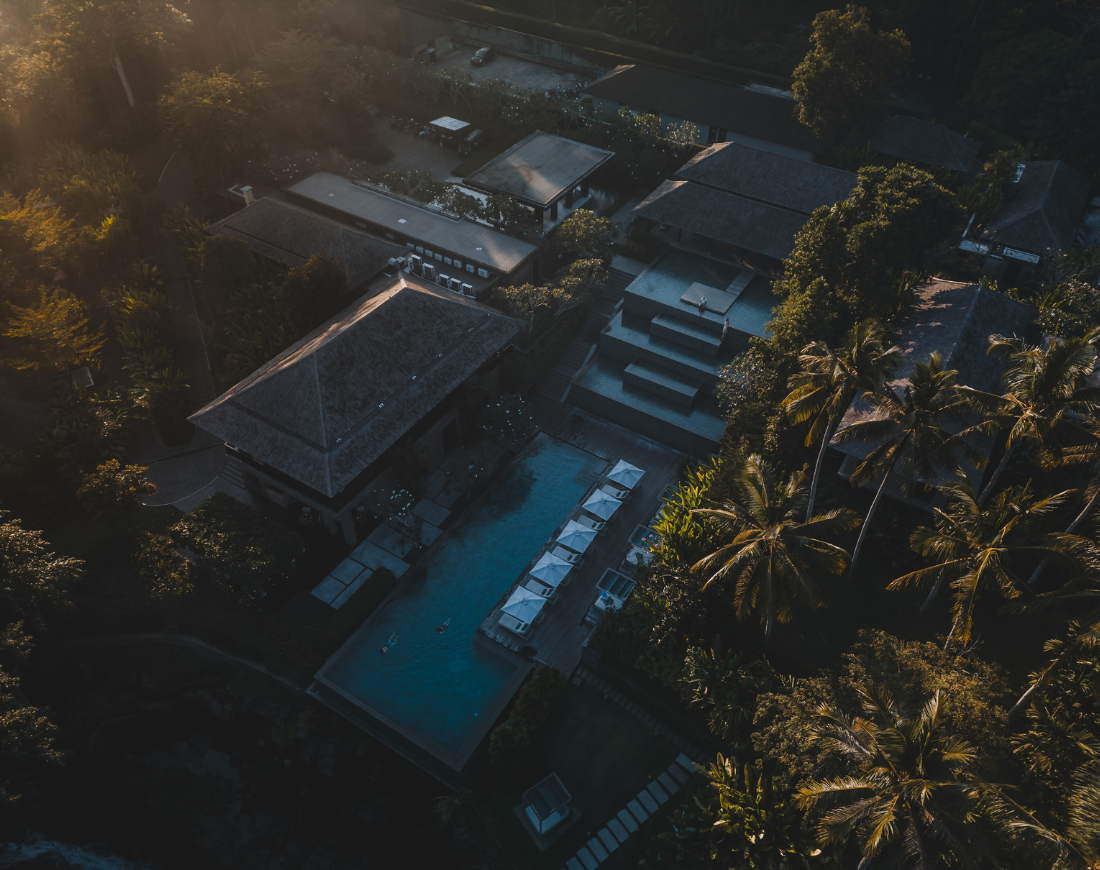
Wet-season afternoons are the argument for staying somewhere you are happy not to leave.
The south — Seminyak, Canggu. Works, but the wet season removes what the area is best at. Traffic worsens in rain and the beach is at its least appealing.
Nyepi falls in March
Worth flagging inside this window: Nyepi, the Balinese Day of Silence, falls in March, and for twenty-four hours the entire island stops. No travel, no work, no lights after dark, nobody leaving their accommodation — and the airport closes completely.
The date follows the Saka lunar calendar and moves each year. Confirm it before booking flights, and do not schedule a departure on that date. The full picture is in the full month-by-month guide to visiting Bali.
Packing and practicalities
- A light rain shell, not an umbrella. Wind makes umbrellas useless in a real storm.
- Shoes with grip. Stone steps at temples and waterfalls are slick.
- Dry bag for a camera and phone.
- Mosquito repellent. Standing water means more mosquitoes; dengue is present in Indonesia.
- Book activities in the morning, without exception.
- Build in flexibility. A fixed hour-by-hour itinerary will fight the weather and lose.
- Do not swim at river-mouth beaches after heavy rain. Run-off, debris and stronger currents.
Bali Rainy Season FAQs
Is it worth going to Bali in the rainy season?
Yes, for the right trip. Mornings are usually clear, the landscape is at its greenest, and both crowds and rates are at their lowest. It is a poor choice if your plan depends on all-day beach weather or west-coast surf.
Does it rain all day in Bali during the rainy season?
Rarely. The usual pattern is a clear morning, building cloud, and a heavy storm in the late afternoon or overnight that passes within two to three hours.
Which months are the rainy season in Bali?
Roughly November to March, with April and October as transitions. January and February are the wettest.
What is the weather like in Bali in November?
The start of the wet season. Showers rather than sustained storms, mornings frequently clear, crowds low. Often the best-value month of the five.
Can you still surf in Bali in the rainy season?
Yes, but the coasts swap. The west and southwest go onshore and messy, while the east coast improves. Most surfers move east between November and March.
Is Bali cheaper in the rainy season?
Rates across the island are generally lower outside the dry season, with the exception of the Christmas and New Year fortnight, which is the most expensive period of the year.


