
Bali's most photographed landscape is also a thousand-year-old engineering system.
The bali rice terraces that fill every Bali photo essay — the green amphitheaters, the staircase paddies, the lone farmer carrying a bundle of seedlings — are not scenery. They are the visible expression of a living, democratic, 1,200-year-old water-sharing tradition called the subak: a Cultural Landscape inscribed by UNESCO in 2012 as one of the most sophisticated agricultural systems on earth. Read that way, the terraces stop being a photo carousel and start being the most interesting cultural site in Bali that you can walk through. This guide takes them one by one — Jatiluwih, Tegallalang, Sidemen, Pupuan, Belimbing and Munduk — with notes on when to go, what to look for and where to base yourself.

Why Bali's rice terraces matter — beyond the photograph
The bali rice terraces are a working system, not a heritage relic. Three rice rotations are planted a year, staggered between subak councils so that water reaches each paddy in turn. The walls that hold the terraces in place are maintained by hand by farming families that have worked the same plots for ten generations. The color of any single hillside on any single morning depends on where that village is in its rotation: emerald in the first weeks after planting, ankle-deep mirror after flooding, gold at harvest, then a brown of cut stubble that lasts about a fortnight. None of that is theater for visitors. It is simply what is happening. Read the landscape this way and the photography improves on its own.
Jatiluwih — the UNESCO one
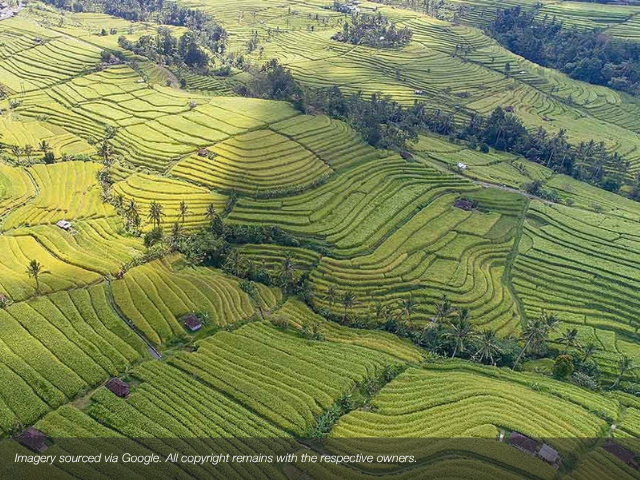
Jatiluwih is the only UNESCO World Heritage rice terrace in Bali. Inscribed in 2012 under the broader Cultural Landscape of Bali Province, it covers roughly 600 hectares of subak-irrigated paddies along the southern slopes of Mount Batukaru, in Tabanan regency. It is the largest contiguous terrace system on the island, and the cultural anchor for the heirloom padi Bali red rice — a slow-growing native varietal protected by a UNESCO-recognized cropping mandate. A network of marked walking trails (red, yellow, blue, green) crosses the paddies; the longest is around six kilometers and takes a comfortable two hours at a guided pace. There is a modest entry fee, paid at the village gate, which is reinvested directly into terrace maintenance.
Best for: Travelers who want cultural and ecological depth in a single visit. Pair with Batukaru Temple, fifteen minutes away.
Tegallalang — the icon
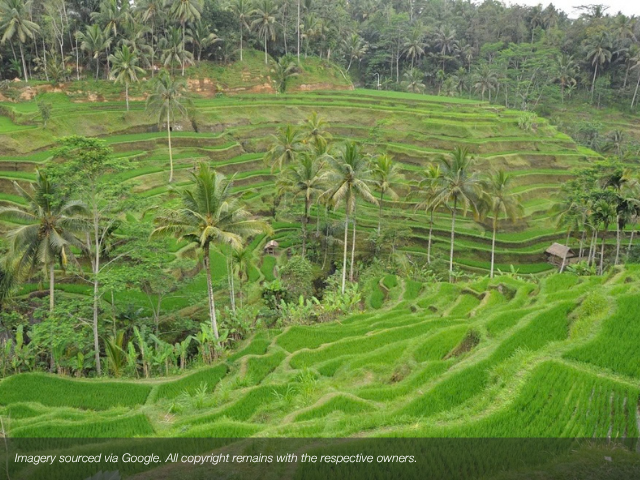
Tegallalang is the most photographed rice terrace in Bali — the sculpted hillsides north of Ubud whose perfect, narrow, fan-shaped paddies have been the cover image of half a generation of travel guides. It is smaller than Jatiluwih, more theatrical, and has commercialised in proportion to its fame: viewing platforms, swings, café terraces, a steady weekend procession of tour minivans. None of that diminishes the actual landscape, which is remarkable. Arrive at sunrise — the gates open at around 7am — and you will have something close to the unmediated version for the first hour.
Best for: First-time visitors who want the postcard frame. Sunrise only.
Sidemen — the valley
Sidemen is the rice-terrace valley in east Bali that travel editors keep quietly to themselves. Set in Karangasem regency at the foot of Mount Agung, it is a working agricultural valley rather than a curated viewing area — farming families still occupy the side of the road, water buffalo still cross at dusk, and the terraces themselves climb from the river up the eastern face of the island's most sacred volcano. There is no signage and no admission. You drive into the valley, find a viewpoint, and walk. Expect a two-and-a-half-hour transfer from southern Tabanan; the distance is the price of paying no other traveler for the view.
Best for: Travelers who want rice terraces without other travelers in them.
Pupuan — the highland drive
Pupuan is less a destination than a road. The terraces climb to roughly 800 meters altitude along the corridor that runs from Tabanan north-west toward the Buleleng coast, threading between clove and coffee plantations on one side and step-cut paddies on the other. It is among the most cinematic drives in Bali — sustained altitude, deep valleys, almost no other traffic outside weekends. Stop at any of the marked viewpoints; the best stretches are between Belimbing and the Pupuan junction, then again on the descent toward Seririt.
Best for: Couples on a self-drive day, photographers, anyone driving to North Bali.
Belimbing — the quiet companion to Jatiluwih
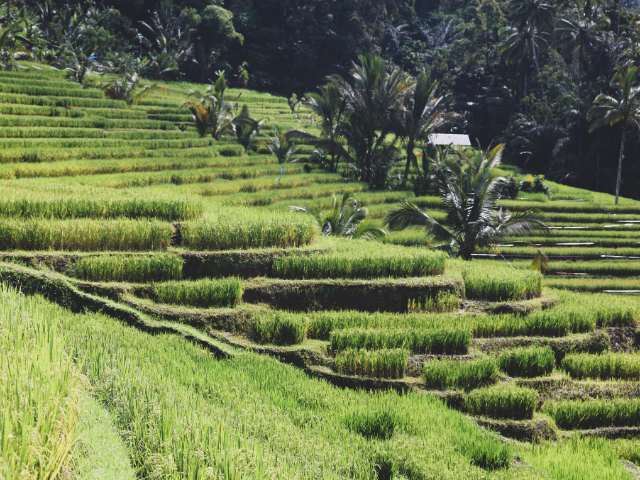
Belimbing is a working farming valley in central Tabanan, roughly fifteen kilometers south-west of Jatiluwih, with almost no signage and almost no tour buses. Its terraced amphitheater — visible from a single roadside lookout above the village — is among the most photogenic in Bali and almost entirely unknown to tour groups. Travelers who plan a full Jatiluwih day routinely overlook it; pairing the two as a half-day each is one of the most underrated itineraries on the island.
Best for: A pairing visit with Jatiluwih — half day each.
Munduk — the highland mist
Munduk sits at around 800 meters altitude in Bali's central highlands, in Buleleng regency, where clove and coffee plantations are integrated directly into the rice-terrace system. It is waterfall country: Munduk, Melanting and Banyumala are all within a forty-minute drive, and Bali's twin crater lakes (Bratan and Tamblingan) are immediately to the north. The climate is cooler — fifteen to twenty degrees in the early morning — and the mist most travelers come to Bali expecting actually settles here. Treat it as a stop on the route to or from North Bali rather than a day trip from the south.
Best for: Travelers heading to or from Bali's lake region.
The subak system — how Bali's rice terraces actually work
The subak is Bali's 1,200-year-old democratic water-sharing cooperative — a network of irrigation channels, weirs and farming councils that allocates river water between rice fields by consensus rather than by ownership. Each subak governs a watershed cluster of paddies, meets in its own water temple (pura subak), and resolves disputes by a vote of the member farmers. The system is anchored in Tri Hita Karana, the Balinese philosophical framework that defines well-being as the balance of three relationships: between people and the divine, between people and each other, and between people and the natural world.
UNESCO inscribed the subak as a Cultural Landscape in 2012 — not the terraces themselves, but the system the terraces visibly express. The recognition matters because it reframes what a visitor is looking at: not a postcard, but a civic institution that pre-dates the Republic of Indonesia by a thousand years.
Nirjhara is itself bordered by a river that forms part of the subak network. The water that runs through the property is the same water that, downstream, irrigates the paddies of Kedungu village. The proximity is not a marketing claim; it is what allowed the property to be built where it is, and what the resort's gardens are watered with. For travelers who come to Bali to understand the subak, the cultural anchor is not in the photo — it is in the geography you actually sleep in.
When to visit Bali's rice terraces
The best months for the bali rice terraces depend on what you want to photograph. December to February delivers the green-wall look — the paddies are full, the rice is mature, and the hillsides read as solid emerald. March and April, and again July and August, are the harvest windows; the same hillsides turn gold, and tractors and hand-cut bundles appear on the slopes. May, June and September are transition months — patchwork tones, lower visitor pressure, and the most reliable weather of the year.
Time of day matters more than month. The bali rice terraces flatten under midday light; visit in the first hour after sunrise (the water in the paddies catches the sky and the terraces read as a mirror) or in the last hour before sunset (the side-light picks out the contour walls). For Jatiluwih and Tegallalang specifically, early arrival doubles as crowd avoidance — the tour groups arrive after nine.

Six rice terraces at a glance
Match yourself to one of the rows below before you commit to a long transfer.
| Rice terrace | Region | Drive from Nirjhara | UNESCO status | Best for |
|---|---|---|---|---|
| Jatiluwih | Tabanan (central highlands) | ~45 min | UNESCO World Heritage (2012) | Cultural depth, the definitive visit |
| Tegallalang | Gianyar, north of Ubud | ~75 min | Cultural Landscape buffer zone | The iconic photograph |
| Sidemen | Karangasem, east Bali | ~2 hr 30 min | Not listed | Travelers avoiding other travelers |
| Pupuan | Tabanan (north-west) | ~1 hr 30 min | Not listed | The most cinematic drive |
| Belimbing | Tabanan (central) | ~1 hr | Not listed | Pairing with Jatiluwih |
| Munduk | Buleleng (central highlands) | ~1 hr 45 min | Not listed | Mist, coffee and a North Bali stop |
Staying near Jatiluwih — Nirjhara as a base
Most travelers planning a Jatiluwih trip default to Ubud, on the assumption that the cultural heart of Bali is also the closest. It is not. Ubud is in Gianyar regency, east of Tabanan, and a Jatiluwih day from Ubud is an hour and twenty minutes each way through the busiest corridor on the island. From Kedungu, Tabanan — where Nirjhara sits, in Bali's green agricultural province — Jatiluwih is a forty-five-minute drive, almost entirely on quiet inland roads.

Nirjhara is a twenty-five villa property bordered by a river that forms part of the subak irrigation network — the same system that, downstream, irrigates Kedungu's paddies. The waterfall at the heart of the property runs straight beneath the pool deck. The Jungle Pool Villa has its own plunge pool cantilevered over the forest; The Residence holds two bedrooms for couples traveling with close friends. Ambu, the farm-to-table restaurant, draws ninety per cent of its produce from Bali, much of it from the 700m² organic garden on site. The yoga shala and The Retreat — bamboo, designed by IBUKU — overlook the valley. Eighty-five per cent of suites have a view of waterfall, rice field or ocean sunset. The property is a member of Small Luxury Hotels of the World.
For a Jatiluwih visit specifically, the resort runs a guided "In the Hills of Tabanan" half-day excursion that pairs the UNESCO terraces with Batukaru Temple and Yeh Ho waterfall — three of the strongest cultural sites in the regency, all within a thirty-minute radius of each other. See more in private experiences in the hills of Tabanan.
Bali Rice Terraces FAQs

Are Jatiluwih and Tegallalang the same thing?
No. They are different sites in different regions of Bali. Jatiluwih is in Tabanan, covers approximately 600 hectares and is UNESCO World Heritage listed. Tegallalang is in Gianyar, north of Ubud, is much smaller in scale, and is not UNESCO listed — but is the more photographed of the two thanks to its dramatic narrow paddies and proximity to Ubud's tourist corridor.
When is the best time to visit Bali rice terraces?
December to February for the green-wall look — paddies are full and the rice is mature. March, April, July and August are harvest months and produce the gold-tone landscape. Visit in the first hour after sunrise or the last hour before sunset; midday light flattens the contours and washes out the color.
What is the subak system?
The subak is Bali's 1,200-year-old democratic water-sharing cooperative — a network of irrigation channels and farming councils that allocates river water between rice fields by consensus, anchored in the Balinese philosophy of Tri Hita Karana. UNESCO inscribed the subak as a Cultural Landscape in 2012; the rice terraces are the visible expression of the system, not the system itself.
Can you visit Jatiluwih in a day from Nirjhara?
Yes. Jatiluwih is approximately a forty-five-minute drive from Nirjhara, which makes the property the most natural luxury base for a UNESCO-terrace visit. Most guests pair Jatiluwih with Batukaru Temple or Yeh Ho waterfall as a half- or full-day excursion through the resort's "In the Hills of Tabanan" guided experience.
Are entry fees required at Bali rice terraces?
Yes, at the two managed sites. Jatiluwih and Tegallalang each charge a modest entry fee — typically IDR 40,000 to IDR 50,000 per person, refreshed annually — which funds maintenance of the terraces and the local subak. Sidemen, Pupuan, Belimbing and Munduk are working farmland and generally free to visit, though a small donation to landowners is customary if you walk through the paddies.
Enquire about a Jungle Pool Villa stay at Nirjhara → nirjhara.com/en/contact/
This guide is maintained by the editorial team at Nirjhara Resort Bali, a twenty-five villa property in Kedungu, Tabanan — a forty-five-minute drive from the UNESCO-listed Jatiluwih rice terraces — and a member of Small Luxury Hotels of the World.


