
A MICHELIN hotel in Bali is not a hotel with a Michelin-starred restaurant. The two awards are separate, they are judged by different inspectors against different criteria, and conflating them is the most common mistake made when the phrase is searched.
The MICHELIN Guide has recommended hotels since the 1920s. What changed recently is that it began awarding hotels their own distinction — the MICHELIN Key — in the way it has long awarded Stars to restaurants. That gives the phrase "Michelin hotel" two possible meanings, and the gap between them is wide.
Selected, or awarded
Being in the MICHELIN Guide and holding a MICHELIN Key are different things.
The Guide's hotel selection runs to more than 9,000 properties worldwide. Every one of them has been chosen; none of them is there by paying. But selection is the entry condition, not the prize. From that selection, inspectors award Keys to the properties they consider the most outstanding — in the Guide's own words, the Key "denotes the most outstanding experiences in our selection".
So a hotel can accurately say it is in the MICHELIN Guide and hold no Key at all. When a property says "MICHELIN hotel" without naming a number of Keys, that is usually what it means.
| Distinction | What it means | How many |
|---|---|---|
| In the MICHELIN Guide | Chosen by inspectors for the hotel selection | More than 9,000 worldwide |
| One MICHELIN Key | A very special stay | 2,020 worldwide |
| Two MICHELIN Keys | An exceptional stay | 657 worldwide |
| Three MICHELIN Keys | An extraordinary stay | 155 worldwide |
What each Key actually means
The Guide publishes a definition for each level, and they are worth reading closely, because the distinction is about character and conviction rather than about thread count.
One Key — a very special stay. "A true gem with personality. Service always goes the extra mile, and the hotel provides much more than others in its price range."
Two Keys — an exceptional stay. "A hotel that's unique in every way, where a memorable experience is always a guarantee. A hotel of character and charm, run with obvious pride and considerable care."
Three Keys — an extraordinary stay. "The ultimate in comfort and service, style and elegance. It is one of the world's most remarkable and extraordinary stays and a destination for the trip of a lifetime."
Note what the One Key definition does, because it is the level most often misread. It explicitly measures the hotel against others in its price range. A One Key property is not a hotel that fell short of Two; it is a hotel judged to give more than its price would predict. That is a different statement from "smaller" or "cheaper".
The five things inspectors judge
Keys are awarded against five criteria, applied the same way everywhere in the world:
- Excellence in architecture and interior design
- Quality and consistency of service
- Overall personality and character
- Value for the price
- Significant contribution to the neighbourhood or setting
Three of those five have nothing to do with facilities. Personality, value and contribution to the setting are judgements about what a hotel is and where it belongs — which is why the Key list is not a list of the largest or most expensive properties on any island.
How to read the Bali field
Bali is well represented. Indonesia has 47 Key hotels in the Guide's selection, and the island accounts for most of them, spread across Ubud, the southern beaches, Canggu, Nusa Dua and the quieter western coast.
Two things are worth knowing before you use the Key list as a shortlist.
No hotel in Bali holds Three Keys. Indonesia's only Three-Key property is Nihi Sumba, on the island of Sumba — a flight and a different proposition entirely. Bali's Key hotels sit at One and Two.
The Keys cluster by setting, not by price. Ubud's Key hotels are jungle and river properties. The southern coast's are beach and resort properties. Canggu's are design-led. Reading the list by region tells you more about what sort of stay you are choosing than reading it by Key count, because a Two-Key beach resort and a One-Key jungle property are not competing for the same trip.
The current roster changes with each annual announcement, so the list on the MICHELIN Guide's own Bali page is the only one worth trusting on a given day.
How the Key is decided
The method is the reason the Key carries weight, and it is worth knowing because it differs from how most hotel lists are built.
Inspectors visit anonymously and pay their own bills. The Guide does not charge for inclusion and properties cannot apply their way in — the selection is made by the Guide, not submitted to it. The hotel selection is reviewed and republished annually, which means a Key is a current judgement rather than a permanent title: properties gain Keys, are upgraded, and in principle can lose them.
That independence is the whole point. A hotel cannot buy a Key, cannot negotiate one, and cannot keep one by spending more on marketing. What it can do is satisfy the five criteria, which are about what the place is rather than what it says about itself.
Keys against the other hotel awards
Travellers meet several hotel distinctions in Bali and they are not measuring the same thing. The differences are methodological, and they explain why the lists do not overlap as much as you would expect.
| Distinction | Who decides | What it measures |
|---|---|---|
| MICHELIN Key | MICHELIN Guide inspectors, anonymously | Architecture and design, service, personality, value for the price, contribution to the setting |
| Magazine and reader awards | Editors, or readers voting | Editorial judgement or popularity, depending on the award |
| Rating systems by stars or diamonds | Assessors against facility checklists | Facilities and service standards, graded against a defined list |
| Consortium membership | The consortium, against its own entry standards | Membership criteria, which usually include a commercial relationship |
The practical reading: a facilities-based rating tells you what a hotel has. A Key tells you what inspectors thought of it, including whether it is worth its price and whether it belongs where it stands. A smaller property with no ballroom and no third pool can hold a Key; a large one with all three may not.
Bali has hotels that appear on several of these lists at once and hotels that appear on only one. Where they diverge is usually the interesting part, and usually explained by size: the awards that reward facilities favour the large resorts, and the Key does not.
Reading the Bali Key map by district
Because the Keys reward character and setting, they sort geographically in a way that is useful as a shortlist.
Ubud and the central river valleys. Jungle, river and ravine properties. These are the Key hotels where the architecture responds to a gorge, and where the draw is the landscape immediately outside the room rather than the beach half an hour away.
The southern beaches and Nusa Dua. Resort properties with the island's most complete facilities and the shortest airport transfers. This is where the larger Key hotels are.
Canggu and the southwest. Design-led and newer. The Keys here tend to go to properties with a strong architectural identity rather than the biggest footprint.
Tabanan and the west. The quietest Key territory, and the least developed. Bali's green agricultural province, worked through the subak irrigation system, with the rice terraces at Jatiluwih inland and a coast most visitors drive past.
If you take one thing from the map it is this: choose the district before you choose the Key count. A One Key property in the district that suits your trip will nearly always beat a Two Key property in the district that does not.
What a Key is worth to you, practically
Three things, and it is worth being plain about the limits of each.
It filters a crowded field. Bali has thousands of places to stay and an unusually high volume of paid recommendation. A list compiled by inspectors who paid their own bills is a short, independent starting point.
It tells you the value judgement has been made. Particularly at One Key, where the definition is explicitly about a property exceeding others in its price range. That is the hardest thing to assess from photographs and the easiest thing to get wrong.
It does not choose your trip. The Key says nothing about whether you want surf or a ravine, a kids' club or silence, thirty minutes from the airport or ninety. Those are your constraints and no award encodes them.
Where Nirjhara sits
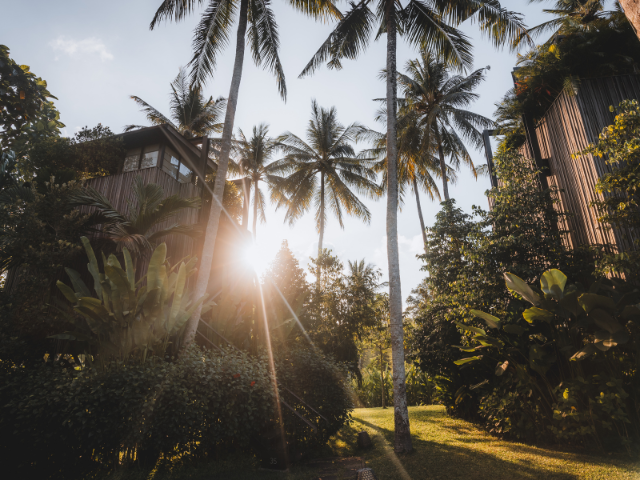
Nirjhara is listed in the MICHELIN Guide with One MICHELIN Key — a very special stay, under Tabanan rather than under Bali's better-known resort districts.
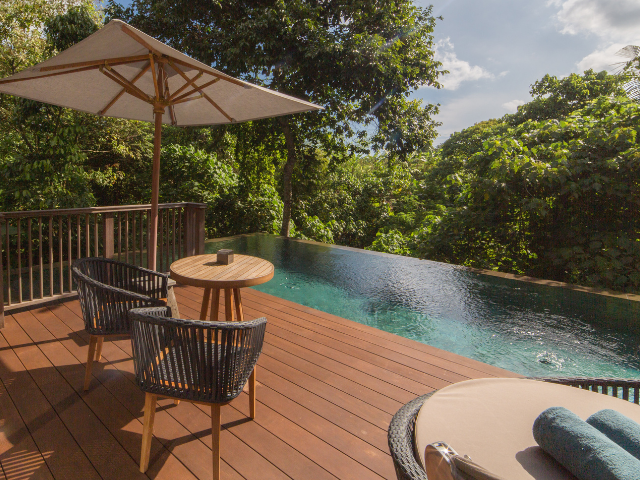
The inspectors' own description points at the things the five criteria reward: villas and suites that blend traditional Balinese architecture with contemporary interiors, a spa with four treatment rooms, two Finnish saunas, an outdoor yoga deck, and an infinity pool overlooking a waterfall. Ambu, the restaurant, is noted for refined Balinese cooking in an open-air setting.

Read against the One Key definition — more than others in its price range, a gem with personality — that is a coherent award. It is a 25-villa property on its own cascade in Kedungu, Tabanan, in Bali's green agricultural province, where 85% of the suites look at river, jungle or rice field. The Guide's fifth criterion, contribution to the setting, is the one a property of that size and location can answer most directly: the organic garden that supplies Ambu runs to 700m², and the yoga shala was built in bamboo by IBUKU.
What the Key does not tell you
It does not tell you the price. It does not tell you the size. It does not tell you whether a hotel suits the trip you are planning — a Two-Key beach resort in the south and a One-Key jungle property in Tabanan are both correctly awarded and almost nothing alike.
And it does not tell you about the food. A MICHELIN Key is a hotel award. A MICHELIN Star is a restaurant award. A hotel can hold Keys and have no starred restaurant, and a starred restaurant can sit in a hotel with no Key at all.
Frequently asked questions
What is a MICHELIN Key?
A distinction the MICHELIN Guide awards to hotels, in the way it awards Stars to restaurants. It is given at three levels — One, Two and Three Keys — to properties the Guide considers the most outstanding within its hotel selection.
Is a MICHELIN Key the same as a MICHELIN Star?
No. Keys are for hotels and Stars are for restaurants. They are assessed separately against different criteria. A hotel may hold Keys without having a starred restaurant.
What is the difference between One, Two and Three MICHELIN Keys?
One Key is a very special stay — a gem with personality that gives more than others in its price range. Two Keys is an exceptional stay, unique in every way. Three Keys is an extraordinary stay, described by the Guide as a destination for the trip of a lifetime.
Is being in the MICHELIN Guide the same as having a Key?
No. The Guide's hotel selection runs to more than 9,000 properties. Keys are awarded to a minority of them. A hotel can be MICHELIN Guide listed and hold no Key.
How many MICHELIN Key hotels are there in Indonesia?
Indonesia has 47 Key hotels in the MICHELIN Guide selection, with Bali accounting for most of them.
Are there any Three-Key hotels in Bali?
No. Indonesia's only Three-Key property is Nihi Sumba, on the island of Sumba. Bali's Key hotels hold One or Two Keys.
How do inspectors decide which hotels get a Key?
Against five criteria: architecture and interior design, quality and consistency of service, personality and character, value for the price, and contribution to the neighbourhood or setting.
Does Nirjhara have a MICHELIN Key?
Yes. Nirjhara holds One MICHELIN Key — a very special stay — and is listed under Tabanan in the MICHELIN Guide.
Can a hotel pay to be in the MICHELIN Guide?
No. Properties are chosen by inspectors. The Guide operates its hotel selection on the same independent basis as its restaurant selection.
Sources consulted
- MICHELIN Guide — All you need to know about the MICHELIN Key — https://guide.michelin.com/en/article/travel/everything-to-know-about-the-michelin-keys-hotels-announcement
- MICHELIN Guide — The 2026 MICHELIN Key Hotels: a guide to the global selection — https://guide.michelin.com/us/en/article/travel/all-the-key-hotels-in-the-world-michelin-guide
- MICHELIN Guide — Every Three-Key hotel in the world — https://guide.michelin.com/us/en/article/travel/every-three-michelin-key-hotel-best-world
- MICHELIN Guide — Nirjhara, Tabanan — https://guide.michelin.com/en/hotels-stays/tabanan/nirjhara-10728
- MICHELIN Guide — hotels in Bali — https://guide.michelin.com/en/hotels-stays/bali


