
The best waterfalls in Bali are not interchangeable. Some demand a six-hundred-step descent through jungle; others sit ten minutes from a paved car park. This shortlist covers the ten most worth your morning — and one that does not require leaving the property at all.

How to read this shortlist
A waterfall in Bali is judged on three things: drama, access and swim-quality. Drama is height, volume, and the amphitheater around the fall. Access is the steps down, the distance from the nearest village, and whether a licensed guide is mandatory. Swim-quality is whether the plunge pool is safe, cold, and worth changing into a swimsuit for. A few sites are sacred — a sarong on entry is non-negotiable — and most charge a modest entry fee in Indonesian Rupiah. We have ordered the shortlist by usefulness rather than drama: the falls most travelers can actually reach in a morning come first.
Tegenungan Waterfall — the easy classic
Tegenungan is Bali's most-visited waterfall, fifteen minutes south of Ubud, reached by a short descent on concrete steps. The fall is a single wide curtain dropping into a brown-green plunge pool. It is best photographed from the upper viewing deck shortly after opening; by mid-morning the crowds are thick and the river surface choppy. There is a small entry fee and a paid car park.
Best for: First-time visitors, families, anyone with mobility limits, travelers staying near Ubud who want a waterfall in a half-morning.
Sekumpul Waterfall — the seven-falls amphitheater
Sekumpul in north Bali is widely considered the island's most dramatic site — a natural amphitheater with seven distinct falls visible from a single viewpoint. The descent is steep, slippery in the wet season, and the official ticket includes a licensed local guide. Plan a full day from south or central Bali; the drive alone is two and a half hours each way.
Best for: Travelers who want the single most cinematic waterfall day Bali offers and are happy to commit a full day to it.
Nungnung Waterfall — the cold, loud one
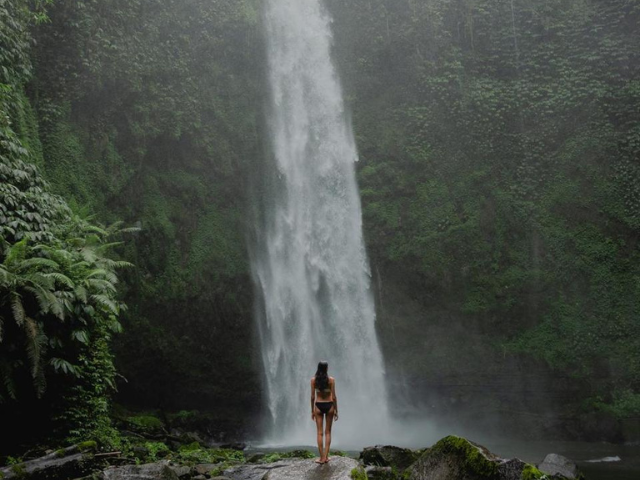
Nungnung is a tall, narrow plunge of cold water in the central highlands. The descent is around five hundred concrete steps — manageable on the way down, demanding on the way back up. The reward is one of Bali's loudest, fastest falls and a plunge pool that is genuinely cold even in dry season. Far less crowded than Tegenungan.
Best for: Cold-water swimmers, photographers wanting motion and spray, hikers comfortable with the climb back.
Banyumala Twin Waterfalls — two falls, one swim
Banyumala sits in the north near Munduk and is the rare Bali waterfall built for swimming. Two parallel falls land in a shared turquoise pool that is shallow at the edges and deep at the center — ideal for a slow afternoon. The walk in is short but uneven; sturdy footwear is helpful.
Best for: Couples and small groups wanting a swim-led waterfall visit without the Sekumpul commitment.
Tibumana Waterfall — the photographer's favorite
Tibumana is a veil of water dropping through a perfect frame of jungle, ten minutes from the car park along a graded path. It is single, narrow, gentle, and surrounded by dense moss-colored walls. The light is best between nine and ten in the morning, when sun reaches the basin without the spray turning to glare.
Best for: Photographers, honeymooners wanting a romantic frame, anyone who values composition over scale.
Aling-Aling Waterfall — slides and jumps in the north
Aling-Aling is a multi-tier site in north Bali where licensed local guides walk visitors through a sequence of natural rock slides and cliff jumps of varying heights. The main fall is sacred and off-limits to swimmers; the lower tiers are the activity. Children under twelve are not permitted at the higher jumps.
Best for: Travelers wanting an active, adrenaline-led waterfall day rather than a contemplative one.
Tukad Cepung Waterfall — the cave light beam
Tukad Cepung is unusual: the fall lands inside a partial cave, and on bright mornings a beam of sunlight slices through the opening above and lights the spray. The walk in includes a short wade through the river — knee-deep in dry season, higher after rain. The light beam is most reliable between ten and eleven o'clock; before nine the cave is in shadow, after noon the angle is wrong.
Best for: Mid-morning photographers, travelers wanting a Bali waterfall that does not look like any of the others.
Gitgit Waterfall — the colonial-era classic
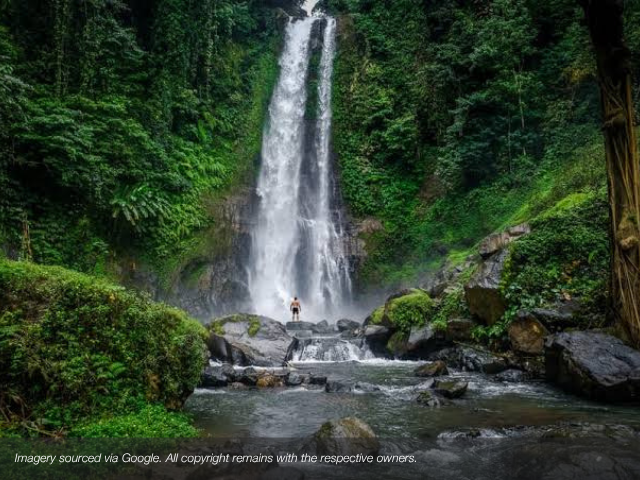
Gitgit is a tall, single drop above Singaraja, signposted since the Dutch era and the most-photographed Bali waterfall before Tegenungan rose. The walk in is gentle, the basin photogenic, the queue manageable. It pairs well with Munduk or Sekumpul on a north-Bali day.
Best for: Travelers building a north-Bali day, or completionists who want the falls that appear in every nineteenth-century travel book.
Leke Leke Waterfall — Tabanan's hidden gem
Leke Leke is Tabanan's quiet alternative — a narrow, jungle-framed fall reached by a short walk through bamboo and rice paddy, around forty-five minutes by car from Kedungu. It is the closest fully-developed waterfall to Nirjhara, and the easiest to fold into an afternoon rather than a full day. Crowds are modest even in peak season.
Best for: Guests staying in Tabanan who want a low-effort waterfall before lunch.
Munduk Waterfall — the highland trio
Munduk is less a single waterfall than a cluster of three (Munduk, Melanting and Labuhan Kebo) connected by graded jungle paths between coffee, clove and cocoa plantations. It is the most rewarding walk on this list — an hour or two of moving through the highlands with multiple falls along the way.
Best for: Travelers who prefer the journey to the destination, and anyone combining waterfalls with a north-Bali highland day.

The only resort built on a waterfall — Nirjhara, Tabanan
Nirjhara is the only luxury resort in Bali built around a natural waterfall. The fall sits at the heart of the property in Kedungu, Tabanan — Bali's green agricultural province — directly beneath the pool deck. There is no trail, no guide, no descent. The waterfall is part of the architecture: the yoga shala designed by IBUKU faces it, the pool deck cantilevers over it, the Jungle Pool Villa suites listen to it.
This is a category of one. Other Bali properties are near waterfalls or arrange excursions to them; Nirjhara is built on one. Twenty-five villas in total; eighty-five per cent with a view of waterfall, rice field or ocean sunset. Ambu, the farm-to-table restaurant, draws from a seven-hundred-square-meter organic garden. The Retreat holds four treatment rooms, two Finnish saunas, and the Five Blessings — a two-hour spa sequence presented on hand-carved lontar parchment. Nirjhara is part of Small Luxury Hotels of the World. Transfer from Ngurah Rai (DPS) airport is approximately ninety minutes. Kedungu beach is two minutes away; Tanah Lot temple, seven.
Best for: Couples and wellness travelers who want the waterfall setting without the hike — the aesthetic of Bali's jungle falls, on a pool deck, in a robe.
Bali waterfalls compared
The shortlist, ordered for planning rather than ranking. Drive times are from Kedungu, Tabanan — adjust by roughly thirty minutes either way for Canggu, Seminyak or Ubud.
| Waterfall | Type | Drive from Nirjhara | Difficulty |
|---|---|---|---|
| Tegenungan | Single, wide curtain | ~1 h 15 min | Easy |
| Sekumpul | Seven-falls amphitheater | ~2 h 30 min | Hard |
| Nungnung | Tall, narrow, powerful | ~1 h 30 min | Moderate |
| Banyumala Twin | Twin falls, swim pool | ~2 h | Moderate |
| Tibumana | Veil-like, jungle frame | ~1 h 30 min | Easy |
| Aling-Aling | Multi-tier with slides | ~3 h | Moderate-hard |
| Tukad Cepung | Cave with light beam | ~1 h 45 min | Moderate |
| Gitgit | Tall single fall | ~3 h | Easy |
| Leke Leke | Hidden jungle fall | ~45 min | Easy-moderate |
| Munduk | Highland trio | ~2 h 30 min | Moderate |
| Nirjhara (on-property) | Resort-set, natural | 0 min | None — at the pool deck |
Planning your waterfall day from Nirjhara

Drive times from Kedungu, Tabanan
Leke Leke is the closest at around forty-five minutes, followed by Tegenungan (one hour fifteen) and Nungnung (one and a half hours). Sekumpul and Munduk are best treated as a full north-Bali day with an early start. The property can arrange a private driver for any of these — guest transport is run by a small group of local drivers organized through the village.
Etiquette — sarong, sacred sites, fees
Most Bali waterfalls charge a modest entry fee in Indonesian Rupiah — usually the equivalent of one to three US dollars per person — plus a small parking fee. Sekumpul includes a mandatory licensed local guide; the ticket cost is correspondingly higher and worth it. Some falls (Aling-Aling's main drop, parts of Tukad Cepung) are sacred and require a sarong on entry; sarongs are typically available for rent on site. Drone use is restricted at most sites and prohibited at sacred ones — check signage on arrival.
Best time of day and year
For light, arrive between eight and ten in the morning at most falls. Tukad Cepung's signature light beam is best between ten and eleven. Dry season (April to October) offers the most reliable access — wet season makes the descents to Sekumpul and Nungnung slippery and the river crossings at Tukad Cepung deeper. November to March brings heavier falls and lower crowds, which suits photographers more than casual visitors.
Best Waterfalls in Bali FAQs

What is the most famous waterfall in Bali?
Tegenungan, near Ubud, is the most visited and most photographed waterfall in Bali. It is also the most accessible — a short walk down concrete steps from the car park — which is why it ranks first for first-time visitors but last for solitude. Sekumpul in north Bali holds the title for most dramatic.
Which waterfall in Bali is the most beautiful?
Sekumpul is widely considered the most dramatic — a seven-falls amphitheater rather than a single curtain. For photographers working with composition rather than scale, Tibumana and Tukad Cepung often win on their own terms. Beauty here is genuinely a matter of which character you respond to.
Are there any hotels with a waterfall in Bali?
Nirjhara, in Kedungu, Tabanan, is the only luxury resort in Bali built around a natural waterfall — the falls sit directly beneath the pool deck, with no trail or external excursion required. Other properties are near waterfalls; Nirjhara has one. The yoga shala faces it, the pool deck cantilevers over it.
How much does it cost to visit waterfalls in Bali?
Most Bali waterfalls charge a modest entry fee in Indonesian Rupiah, typically the equivalent of one to three US dollars per person, plus a small parking fee. Sekumpul is higher because a licensed local guide is mandatory. Cash in IDR is expected — most sites do not accept cards.
Can you swim in Bali's waterfalls?
Yes at several — Banyumala Twin, Tibumana, Nungnung and Aling-Aling all have plunge pools that allow swimming. Water temperatures are noticeably cold, especially at altitude. The main fall at Aling-Aling and parts of Tukad Cepung are sacred and off-limits to swimmers.
Enquire about a Jungle Pool Villa stay at Nirjhara → nirjhara.com/en/contact/
This guide is maintained by the editorial team at Nirjhara Resort Bali, a twenty-five villa property in Kedungu, Tabanan, built around a natural waterfall, and a member of Small Luxury Hotels of the World.


